The short answer: soy candles are made from hydrogenated soybean oil, a renewable, vegan plant wax that tends to burn more slowly than paraffin. Peer-reviewed tests haven't shown any wax is clearly healthier, because fragrance, wick and burning habits matter more. Flo's Candle House hand-pours every candle in soy, and this guide shows you how to choose and burn one well.
Updated 3 November 2026 by Flo, founder of Flo's Candle House, Caldicot, Wales.
Key facts
- Every Flo's Candle House candle is hand-poured to order in 100% natural soy wax with a cotton wick. All are vegan and CLP labelled, from £9 to £14.50.
- Trim the wick to 5mm before every burn. The US National Candle Association (NCA) says ¼ inch, about 6mm.
- The NCA advises a first burn of about one hour per inch (2.5cm) of diameter, and no more than four hours at a time.
- A 2021 peer-reviewed study of palm, paraffin, soy and stearin candles found no wax had a consistently better emission profile. Candle trade associations funded it.
- In that study, scented candles emitted more volatile organic compounds (VOCs) than unscented ones, which emitted only traces.
- UK fire services, citing the Fire Kills campaign, link candles to around 300 casualties a year. In 2024, about 31% of candle fires attended caused death or injury.
- In Great Britain, scented candles need both fire safety labels (BS EN 15494) and CLP labels. Wax melts need CLP labels only.
- Frosting, the white crystalline bloom on soy wax, is natural and cosmetic. It doesn't make a candle unsafe.
This guide answers the questions people ask most about soy candles. You'll find what's in them, how they compare with paraffin, how to fix tunnelling and frosting, and how to burn them safely around children and pets. It works for any soy candle, wherever you bought it.
In this guide
- Key facts
- What are soy candles made of?
- Are soy candles better than paraffin?
- Which soy candle should I buy?
- What length should I trim a candle wick to?
- How long should I burn a candle the first time?
- What is candle tunnelling and how do I fix it?
- Why is my soy candle frosting?
- Why doesn't my soy candle smell strong?
- How do I burn a candle safely?
- Are soy candles safe around dogs and cats?
- How should I store soy candles, and do they go off?
- Can you burn sculptural soy candles?
- Ordering and delivery
What are soy candles made of?
A soy candle is soy wax, a wick, and usually fragrance and colour. Soy wax is soybean oil that has been hydrogenated, which turns the liquid oil into a solid at room temperature. Chemically it's a mixture of triglycerides, the same family of fats as cooking oils. It's plant-based, renewable and vegan.
The wax is rarely the part to worry about. According to HSENI (n.d.), the Northern Ireland health and safety regulator, wax itself is non-hazardous, but fragrance and colour may be. That's why a scented candle carries a CLP label listing any allergens, which we explain in the CLP section below.
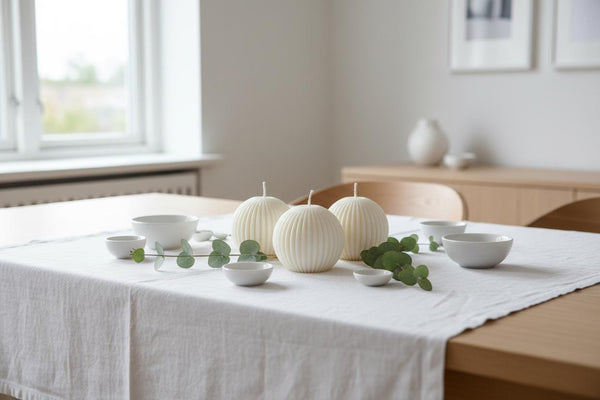
How far the oil is hydrogenated changes how hard the wax is and when it melts, so there's no single "soy" melting point. Container blends are soft and cling to a jar. Moulding blends set firmer, so a candle can stand on its own and hold fine detail. Think of the fur on a cockapoo candle or the ribs on a ribbed sphere.
Soy has a soft, matte finish rather than a gloss, and takes muted colours well. It's also a little temperamental. It reacts to temperature changes as it sets and while it's stored, which explains most of the quirks in this guide.
What wax and wicks do Flo's Candle House candles use?
Flo's Candle House candles are made from 100% natural soy wax with cotton wicks. Every candle and wax melt is vegan and carries a CLP safety label. They're hand-poured to order in Caldicot, Wales, and come in eight scents or Unscented, so you can choose fragrance-free if you prefer.
Are soy candles vegan?
Soy wax itself is vegan, because it's made from a plant oil. A candle is only fully vegan if nothing else in it comes from animals, such as beeswax or some stearin blends. Check the description or ask the maker. Everything Flo's Candle House makes is vegan.
Are soy candles better than paraffin?
Soy isn't clearly better than paraffin for your health or air quality, but it is renewable, vegan and tends to burn more slowly. The best recent study found no wax type had a consistently better emission profile. Fragrance, wick size and how you burn a candle make more difference than the wax itself.
| Wax | Made from | Good at | Watch out for |
|---|---|---|---|
| Soy | Hydrogenated soybean oil | Vegan, renewable, slow-burning, creamy finish, holds detail in moulds | Frosting, needs a full first burn, softer in heat |
| Paraffin | A by-product of petroleum refining | Cheap, strong scent throw, glossy, very consistent | Not renewable; quality varies between grades |
| Rapeseed | Rapeseed oil, often grown in the UK and Europe | Plant-based, grown closer to home, creamy | Similar quirks to soy, frosts easily, less common |
| Coconut blends | Coconut oil, usually blended with other waxes | Smooth finish, good scent throw | Usually a blend, often more expensive |
| Beeswax | Made by honeybees | Natural honey scent, long burn, golden colour | Not vegan, expensive, rarely heavily fragranced |
Do soy candles produce less soot?
In one older lab study, yes. According to Rezaei, Wang and Johnson in JAOCS (2002), paraffin candles produced "a considerable amount of soot", while soy candles produced little or none. That study is small, over 20 years old and predates modern paraffin and wicks.
Every flame makes some soot, whatever the wax. A long wick, a draught or a flame that flickers will make far more. If you see black marks on a wall or ceiling, trim the wick and move the candle somewhere still.
Are soy candles toxic, or safe to breathe?
No candle wax has been shown to be uniquely harmful, and none is proven harmless. The largest recent study found that, in most cases, indoor emissions from burning candles stayed well below guidance values. It also found fragrance mattered more than wax, and unscented candles emitted only traces of VOCs.
According to Salthammer and colleagues in Environment International (2021), "no individual wax was shown to have a consistently better emission profile than the others." The researchers at Fraunhofer WKI ran 24 burn tests on palm, paraffin, soy and stearin, scented and unscented. A few pollutants, including nitrogen dioxide and acrolein, exceeded guide values in some cases. Beeswax and rapeseed weren't tested.
Who paid for it matters: candle trade associations in Europe, the US and Latin America funded the study, and some co-authors came from industry, though it was peer-reviewed. A widely shared 2009 claim that paraffin is harmful was never peer-reviewed at all. The honest summary: choose soy because it's renewable and vegan, not because it's proven healthier.
If you want the lowest emissions from any candle, choose Unscented, keep the wick trimmed, burn for four hours or less and ventilate the room afterwards.
Is there such a thing as a "clean" or toxin-free candle?
No. Any burning candle releases some particles and combustion products, whatever the wax. Words like "clean" and "toxin-free" have no agreed meaning for candles, and UK rules ban similar safety claims from CLP labels. Look instead for a clear CLP label, a named wax and an Unscented option.
Do soy candles last longer than paraffin?
Often, yes. The 2002 Rezaei study found soy burned "significantly slower" than paraffin and needed less air. In practice, wick size and burning habits matter just as much. The NCA says trimming the wick every couple of hours can help a candle burn up to 25% longer.
How many hours you get depends on the candle's size, shape and wick, so be wary of burn times that sound generous. Short, full burns and a trimmed wick get the most from any candle.
Are soy candles eco-friendly?
Soy wax comes from a crop that's replanted every year, so it's renewable in a way paraffin, a petroleum product, isn't. How green a particular soy wax is depends on where and how the soybeans were grown, which varies by supplier. Burning less, and fully using what you buy, helps whatever the wax.
Is rapeseed, coconut or beeswax better than soy?
Each has strengths, but no peer-reviewed emissions data shows any of them is healthier than soy. Rapeseed is grown closer to home and behaves much like soy. Coconut is usually a blend. Beeswax has a lovely honey scent but isn't vegan, and it's usually more expensive.
For shaped and sculptural candles, the key thing is a firm moulding wax that holds detail. That's why freestanding animal and breed candles are often made in a moulding soy.
Which soy candle should I buy?
Choose by what the candle is for. For a gift that looks like someone's dog, pick a breed candle. For display or styling, choose a sculptural shape. For the strongest fragrance, wax melts give more than a small candle. Choose Unscented for memorials, fragrance-sensitive people, or homes with cats and birds.
| You want | Choose | Price | Good to know |
|---|---|---|---|
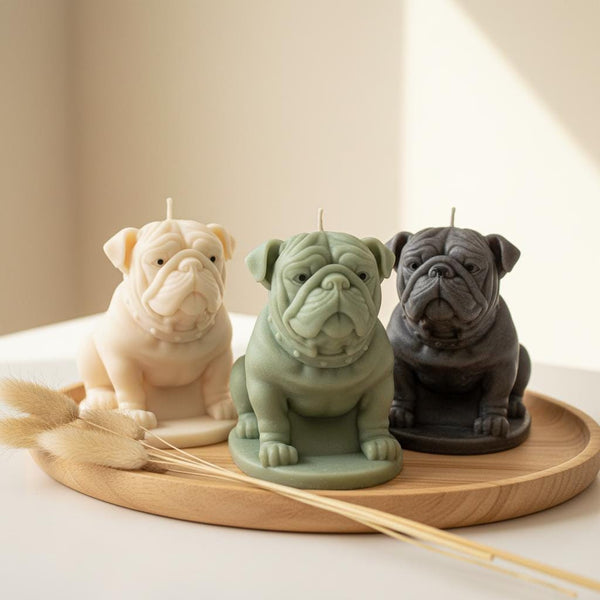
| A candle that looks like your dog | Dog breed candles | £9.50–£14.50 | 13 breeds, chosen in a coat colour to match |
| A cute animal for a gift or nursery shelf | Animal candles | £11.50–£12.50 | Cat, llama, teddy bear, elephant |
| A decor piece for a shelf or mantelpiece | Sculptural candles | £9–£13.50 | Includes the ribbed sphere featured in Good Housekeeping UK, December 2026 |
| A christening or Easter candle | Cross candle | £13 | See also the Easter collection |
| Halloween and autumn | Ghost or pumpkin | £10 each | The only candles offered in Pumpkin Spice |
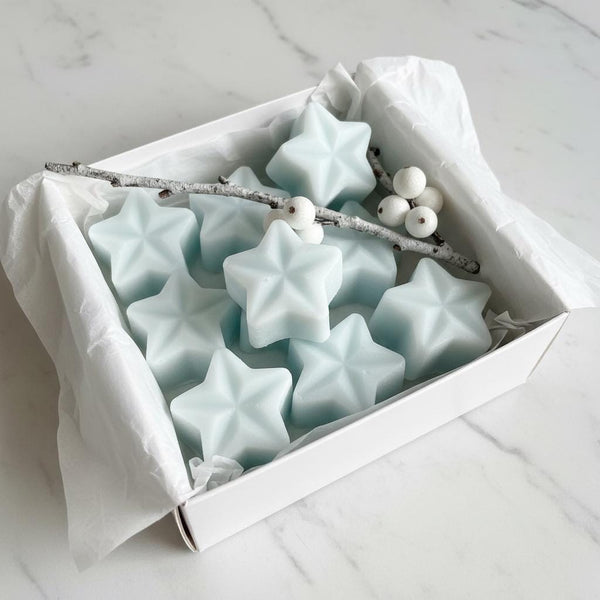
| The most fragrance for the money | Soy wax melts | £4.95 for 5, any 3 packs £12 | About 6–8 hours of fragrance per melt, for use in a wax burner |
| A gift under £10 | French bulldog or flower | £9.50 / £9 | More in gifts under £10 |
| Branded candles for clients or staff | Corporate candles | £12 each, minimum 10 | White soy in a glass jar, custom logo label, about 30 hours' burn |
Flo's Candle House reviews average 4.8 out of 5 from 34 verified buyers. Many people tell us their candle is "too cute to use", and plenty are kept on a shelf rather than lit. Both are fine: see burning sculptural candles if you do want to light one.
Which candle scent should I choose?
Every Flo's Candle House candle comes in Vanilla, Lavender, Coconut & Lime, Apple & Cinnamon, Fresh Linen, Sandalwood, Rose or Snow Angel, or Unscented. You choose the scent when you order. Pumpkin Spice is also offered on the ghost and pumpkin candles.
| Choose | When it suits |
|---|---|
| Unscented | Memorial candles, display pieces, fragrance-sensitive people, homes with cats, birds or a new baby |
| Apple & Cinnamon, Snow Angel | Autumn and Christmas gifting (see our Christmas candle guide) |
| Fresh Linen, Lavender | Bedrooms and bathrooms, if you like a fresh or floral scent |
| Vanilla, Sandalwood, Rose, Coconut & Lime | Living rooms and everyday gifts, depending on taste |
A small sculptural candle gives a gentle scent rather than filling a big room. For more on matching fragrances to spaces, see the scent section of our wax melts guide. If you can't decide, a scent you know the person already likes is the safest choice.
How do I choose a colour, or match a candle to my dog?
Pick the coat colour closest to the dog when you order. Most breed candles come in Ivory/Cream, Warm Biscuit/Sand, Chocolate Brown, Charcoal/Near Black, Sage Green and Blush Pink, and some breeds have their own shades. If you're unsure, send us a photo before ordering and we'll help you choose.
Some breeds have specific coat options. The dachshund (sausage dog) candle comes in Chocolate, Tan, Cream, Red, Black and Blue/Grey. The Shiba Inu comes in Red, Sesame, Tan, Cream, White and Black. Our dog breed gift guide helps you choose by breed and occasion, and its coat colour section explains how to match a candle to your dog. To send a photo, use our contact page.
What length should I trim a candle wick to?
Trim the wick to 5mm before every burn. That's the guidance for all Flo's Candle House candles. The US National Candle Association says ¼ inch, about 6mm, so the two are very close. A short, straight wick gives a steady flame, less soot and an even melt.
The wick draws melted wax up to the flame, which vaporises the wax and the fragrance with it. Too small a wick can't melt the wax to the edges, so you get tunnelling and a weak scent. Too big, and the flame is tall, smoky and burns too fast. Cotton wicks are a reliable choice for soy.
Trim when the candle is cool, using nail scissors or a wick trimmer. Brush the trimmings away so they don't fall into the wax.
What is wick mushrooming?
Mushrooming is a black blob of carbon that builds up on the tip of a long wick, making the flame bigger and sootier. Trim it off before the next burn. According to the National Candle Association (2018), burning for over four hours lets carbon build up and can produce a dangerously large flame.
Why is my candle flame flickering or smoking?
A flickering or smoking flame usually means the wick is too long or there's a draught. Put it out, let it cool, trim to 5mm, move it somewhere still and relight. If the flame is tiny and drowning in wax, carefully pour a little melted wax onto kitchen paper, never down the sink.
Why won't my candle wick stay lit?
A wick usually goes out because it's been trimmed too short or is buried in melted wax. Let the candle set, then gently scrape away a little wax around the wick to free about 5mm. If the wick has curled into the wax, straighten it while the wax is still soft.
How long should I burn a candle the first time?
Burn a new candle until the melted wax reaches the edges. The NCA's rule of thumb is about one hour per inch (2.5cm) of diameter, so a 5cm-wide candle needs roughly two hours. Never go past four hours, even if the edges haven't melted.
Soy wax has a "memory". The size of the first melt pool tends to set the size for every burn after. Blow a new candle out after twenty minutes, and the next burn will usually melt only that small circle. That's a memory ring, and it's the start of tunnelling.
- Pick a time when you'll be in the room for a while.
- Stand the candle on a heatproof surface, away from draughts and anything flammable.
- Trim the wick to 5mm, light it and let the melt pool reach the edges.
- Snuff it out and let it harden completely before moving it.
How long can you burn a candle at a time?
No more than four hours at a time, according to the NCA. After that, the wick can grow too long, carbon builds up and the wax or container gets hotter than it should. The NCA also suggests letting a candle cool for at least two hours before relighting.
What is the 3-hour candle rule?
The "3-hour rule" is a rule of thumb some makers use. Burn for up to about three hours, so the melt pool reaches the edges without overheating. It isn't an official UK rule. The most widely quoted guidance, from the NCA, is one hour per inch of width and never more than four hours.
What is candle tunnelling and how do I fix it?
Tunnelling is when a candle burns straight down the middle and leaves a wall of unmelted wax around the edge. It usually starts with a short first burn. You can often fix it with a foil collar and one long, supervised burn in a warm, still room.
Tunnelling wastes wax, weakens the scent and can drown the wick. The NCA warns that once a memory ring forms, a candle "will continue to tunnel for the life of the candle" unless corrected. Other causes are lots of short burns, a wick too small for the width, draughts and a cold room.
- The foil method. Wrap kitchen foil around the top of the jar, leaving an opening over the flame. Stay with it while it burns. The foil reflects heat onto the edges so they melt level, and it gets hot, so remove it carefully.
- A longer burn. For a shallow tunnel, one supervised burn of up to four hours can be enough.
- Scoop and level. If the wick is drowning, scoop out some of the wall once cool. The scooped wax can go in a wax burner.
Freestanding candles don't tunnel in the same way, because there's no jar holding the wall in. Instead, the edges may stay standing while the centre melts, which is part of how a shaped candle changes as it burns.
Why is my soy candle frosting?
Frosting is a white, crystalline coating that forms naturally on soy wax as it cools and goes through temperature changes. It isn't mould or dust. It doesn't change how the candle smells or burns, and it's a sign you're looking at real plant wax.
According to Candle Shack (n.d.), a UK supplier, frosting is "a mild type of polymorphism", where wax exists in more than one crystal form at once. It says soy and rapeseed are "particularly prone" and frosting "is frequently unavoidable". That's a vendor's explanation, so treat it as practical rather than scientific.
You can't prevent it completely, but a steady storage temperature keeps it to a minimum. On a sculptural candle, buff light bloom gently with a soft, dry cloth. Don't use a hairdryer on a detailed piece, or you'll melt the detail too.
Why does my soy candle have wet spots on the glass?
Patches that look wet on a glass jar are usually places where the wax has pulled away from the glass as it cooled and shrank. They're cosmetic and don't affect burning or scent. Temperature changes make them more likely, so a steady room helps. Freestanding candles don't get them.
Why is the top of my candle bumpy or cracked after burning?
A bumpy, rough or cracked top after burning is normal for soy wax. As the melt pool cools, soy sets unevenly and can form small craters. It melts smooth again on the next burn, so there's nothing to fix. Cooling away from draughts and cold windows helps it set more evenly.
Why doesn't my soy candle smell strong?
A soy candle smells weaker when the melt pool is small, the room is large or the wick has drowned. A well-made soy candle with a full melt pool can scent a room nicely. No peer-reviewed study compares scent strength by wax, so this comes from makers' experience rather than lab data.
Cold throw is how a candle smells unlit; hot throw is how much fragrance fills the room while it burns. They don't always match. Fresh, citrusy and sweet notes tend to carry more than soft woods. A candle that's subtle in an open-plan room can feel strong in a bathroom.
- Let the melt pool reach the edges. Most fragrance is released from the pool, not the flame.
- Use a smaller room, with the door closed for a while, then ventilate afterwards.
- Keep the wick at 5mm. A drowned or very short wick gives a small pool.
- Try wax melts if you want strong fragrance. Soy wax melts often give more than a small sculptural candle.
Our wax melts guide explains how to use them and compares melts with candles.
Why has my candle lost its scent?
Fragrance in a candle slowly fades over time, faster in warm, bright places or without a lid. A candle that's been on a sunny windowsill for months may smell faint. Store scented candles somewhere cool and dark, and enjoy them within a year or so for the best fragrance.
How do I burn a candle safely?
Never leave a lit candle unattended, stand it on a heatproof surface and keep it away from anything flammable, draughts, children and pets. Trim the wick to 5mm, burn for no more than four hours and put it out fully before leaving the room or going to bed.
The numbers are sobering. According to Warwickshire Fire and Rescue Service (2024), candles are linked to around 300 casualties a year in the UK. About 31% of candle-related fires result in death or injury. The 300 figure is a long-standing Fire Kills campaign number, repeated each October in Candle Fire Safety Week.
Everyday candle safety checklist
- Never leave a burning candle unattended, and never fall asleep with one lit.
- Use a stable, heatproof surface. Stand sculptural candles on a heatproof plate, because melted wax can run.
- Keep candles away from things that catch fire: curtains, shelves above, bedding, books, decorations and paper.
- Ventilate the room, but avoid draughts, open windows and fans.
- Keep them out of reach of children and pets, where they can't be knocked over.
- Don't move a lit candle or burn several close together, as they can flare.
- Don't stand candles on the side of the bath. Fire services warn bathtubs can melt.
- Fit smoke alarms and test them monthly.
Can you leave a candle burning overnight?
No. Never leave a candle burning while you sleep or when you leave the room. UK fire services are clear that every candle should be put out fully before bed. If you love the glow at night, a battery-powered LED candle gives a similar look without a flame.
Are LED candles safer than real candles?
Yes, for fire risk. A battery LED candle has no flame, so it can't set light to curtains or bedding. According to London Fire Brigade (2025), flameless LED candles "are safe even if you fall asleep". They suit bedrooms, children's rooms and busy Christmas displays.
How far apart should candles be?
Leave at least 10cm between burning candles, and never place them under shelves or in enclosed spaces. That's the advice from Dorset & Wiltshire Fire and Rescue Service (n.d.). The US NCA suggests at least three inches, about 7.5cm. Candles too close together can melt into each other or flare.
Is it safe to blow out a candle?
Blowing gently works, but a snuffer is better because it stops hot wax spattering and makes less smoke. According to Lancashire Fire and Rescue Service (n.d.), you can also dip the wick into the molten wax. Never use water, which makes hot wax spit and can crack glass.
The UK labelling standard, BS EN 15494, includes an optional warning: "Snuff the flame out, do not blow it out". If you dip the wick, straighten it straight away so it's ready for next time.
When should I stop burning a candle?
Stop a container candle when about 1cm of wax is left, so the glass doesn't overheat. According to the National Candle Association (n.d.), stop at ½ inch (about 1.3cm) for containers and 2 inches for pillar candles. For a sculptural candle, stop well before the flame nears the plate beneath it.
Can I burn a candle in the bedroom or bathroom?
You can, as long as you stay in the room and put it out before you sleep or leave. In a bathroom, keep candles off the side of the bath, which fire services warn can melt, and away from towels. In a bedroom, keep them well clear of bedding and curtains.
What is a CLP label on a candle?
A CLP label tells you about fragrance ingredients that could cause an allergic reaction, plus safety warnings and the maker's contact details. CLP stands for Classification, Labelling and Packaging. In Great Britain, scented candles must carry both CLP information and fire safety warnings.
According to the Trading Standards and British Candlemakers Federation advice pack (2024), a sensitising ingredient at 0.1% or more must be named with "May produce an allergic reaction". Wax melts need CLP labels, but the candle fire warnings don't apply to them. Words such as "non-harmful" and "ecological" are banned from CLP labels.
The same pack says CLP information on a product label should also appear on the seller's website. Every Flo's Candle House candle and wax melt carries a CLP label. It's worth reading if you have allergies or sensitive skin, and Unscented is always available.
Do candles affect indoor air?
Any candle releases small particles and combustion products, much like cooking does. The 2021 Salthammer study found indoor levels stayed well below guidance values in most cases. Ventilate the room and keep burns to four hours or less. If anyone has asthma, ask your GP and consider Unscented.
Are soy candles safe around dogs and cats?
Many pet owners burn candles with sensible precautions, but no candle can honestly be called pet-safe. The biggest risk is physical: a tail or paw knocking a lit candle over. Cats are more sensitive to some fragrance ingredients, so ask your vet if you're unsure.
According to PDSA (2026), "a wagging tail knocking over a lit candle" can start a serious fire. Pets jump onto shelves and counters, so check those surfaces too.
According to the Pet Poison Helpline (2026), cats lack a liver enzyme needed to process certain essential oils, including citrus, cinnamon and peppermint. That evidence is mostly about concentrated oils rather than candles. Even so, Unscented is the cautious choice for homes with cats, birds or pets with breathing problems.
- Keep the flame high, on a mantelpiece rather than a coffee table, and never leave pets alone with it.
- Leave a door open so pets can move away from a scent.
- Watch for drooling, vomiting or breathing trouble, and call your vet if you see them.
- Store candles and melts out of reach. A dog-shaped candle can look very like a toy.
What should I do if my dog eats a candle?
Call your vet straight away, and tell them what was eaten and how much. Swallowed wax mainly risks a stomach upset or a blockage, and a wick or fragrance adds to that. Don't try to make your pet sick unless a vet tells you to.
According to a US vet quoted by Rover UK (2024), "wax can cause gastrointestinal issues and even blockage." Keep the packaging or CLP label to show your vet. The pets section above has more on burning candles around dogs.
Can I burn candles around birds?
Take extra care, and ask an avian vet. Bird keepers are often cautious about fumes, but no authoritative UK source we've found gives clear guidance on candles and birds. If you keep birds, burn candles in a different, well-ventilated room, or choose Unscented or an LED candle instead.
How should I store soy candles, and do they go off?
Store soy candles somewhere cool, dry and dark, away from sunlight and temperature swings. They don't go off in a harmful way, but fragrance slowly fades, so scented candles are nicest within a year or so. A display candle kept out of the sun stays looking good much longer.
A drawer or cupboard is ideal. Avoid windowsills, radiators, conservatories and cold garages. Dust detailed pieces gently with a soft make-up brush. Strong sunlight can fade coloured wax over time, so display shaped candles out of direct sun.
Do soy candles melt in hot weather?
Soy candles soften in strong heat and can bend or lose detail, but a normal room won't melt them. Soy's melting point varies by blend. According to Serwax (2025), a wax supplier, soy melts at about 49–82 °C, so keep candles out of hot cars, conservatories and sunny windowsills.
How do I get candle wax off a surface?
Let spilled wax harden fully, then lift it off gently with a plastic card or blunt knife. Don't wipe it while it's hot, which spreads it. On fabric, test any method on a hidden area first, and check the care label. This is one reason to always use a heatproof plate.
Can you burn sculptural soy candles?
Yes, but expect the shape to change as the top melts. Stand a sculptural candle on a heatproof plate to catch run-off, burn in shorter sessions and never leave it unattended. Many people keep them purely for display, which is a perfectly good use.
Most Flo's Candle House candles are freestanding: a labrador, a cat, a bow. If you light one, detail softens from the top and thin parts go first, such as ears and bow loops. Stop before the flame gets close to the plate. Unscented suits pieces you mainly want to display.
For shapes and styling, see our sculptural candles guide, and for step-by-step burning, its section on burning a sculptural candle. Lighting a candle in memory of a pet? Our pet memorial guide can help. For candles among decorations, the Christmas candle guide covers safe styling, and candles for special occasions covers christenings, babies and weddings.
Ordering and delivery
Every candle is made to order and dispatched in 3–5 working days, with free tracked Royal Mail UK delivery and no minimum spend. In a hurry? Express (£6.99) is made first and dispatched within 3 working days by Royal Mail Tracked 24. Add a free gift message in the cart and send it straight to the recipient. The Christmas last order date is Thursday 10 December, or Monday 14 December with Express. Full details, including returns, are on our shipping and returns page.
Still have a question? Try our FAQs or send us a message. When you're ready, browse our sculptural soy candles.